Digby takes to the open road (2)
The Thrill of the Open Road: Can you Survive without a Smartphone?
Generation by generation we become less able to cope without specialist help. My grandfather could set up and run a small gold mine. My father’s first car was a 1927 Morris Cowley and he was enough of a mechanic to back worn crankshaft bearings with leather from his belt and get back to a garage after breaking down in a game reserve. He taught my mother to drive it, with its inadequate braking and ponderous steering and its crash gearbox (even armoured cars have automatic gearboxes today!) There was a rudimentary driving test and Mother drove up the Main Street in Bulawayo, U-turned round the Memorial and returned. She passed but the policeman-examiner said: “I can tell who taught you to drive. No one else corners like that.” The third generation: like most men I could carry out maintenance, adjust carburettors, decoke the valves, but by 1968 left the latter job on an Alfa Giulia to the garage. And the future: driverless cars, in the hands of AI
A Giulia wasn’t ideal for bundu (bush) bashing – its aluminium sump hung low, ready to be displaced by rocks: I carried oil and water and a sealant for bodge repairs. My most memorable motoring adventure was the 1,800 miles to Cape Town and 1,800 back, two days each way, solo. Not too dangerous on open roads: start off at pace, stop for cool drinks, when dusk approached ease up. Sleep overnight in a tent, or just in a bag on a groundsheet. (Once two of us kipped in a layby off the main road: try that today!) Then the underfloor brake master cylinder, prone to rusting, seized – only bleeding would free it. I managed the last 900 miles using the gears and handbrake to slow (a jab on the hydraulic brakes in reserve) – requiring anticipation through the traffic lights in Pietersburg. I can see the look on the hitchhiker’s face when I explained, “Sorry, I can’t use the brakes,” but he enjoyed the challenge.
I went everywhere in Rhodesia (pursuing my job as oral historian or my hobby of visiting ancient monuments), sometimes travelling over the grass-spined tracks of the Tribal Trust Lands. Once, on a remote farm in midwinter, I had to open and shut five gates. There was a herd of curious cows at one, so I pushed them aside; of course I left the engine running; of course I closed the doors to stop a slobbering beast from poking her nose in; but if you’d locked the car you needed keys to open it…. Now with any other car I could have gently forced the quarter light but the Giulia’s was cranked down tightly with a beautifully designed knob. Patting cows out of the way, I had to use all my strength to force it, and thereafter it whistled in crosswinds. But the interviewee, a child during the 1896 Rebellion, had seen much worse.
Even in the 1970s, if you broke down, and your toolkit or knowledge was insufficient to get you going again, you relied on someone stopping to help or walking to the nearest phone in a farmstead. Actually, a stoppage became more fraught in the 1970s because some people were frightened to slow up.
During the rainy season before high level bridges were built, drivers had been regularly halted or trapped between rivers, especially on the Fort Victoria (Masvingo) to Beit Bridge route. I think it was at the Lion & Elephant on the Bubi (Bubye) River that we were stranded for two nights and my mind’s eye visualises the brown torrent obscuring the bridge, then the debris from upriver decorating the guard rails and forming a partial dam, and then the brushing away of the mud. My nose remembers the smell of rotting vegetation. And my ears the plod of the diesel generator. One year, I remember, the proprietors adopted a little duiker, separated by flood from its mother. Some families were bedded in the reception rooms of the main building or crammed into a cubbyhole but we three were lucky with a rondavel to ourselves and needed only to contend with the odd googa (creepy-crawly) dropping from the thatched roof or a trio of scorpions on the whitewashed wall or a centipede in a careless slipper. (712 to here)
In South Africa in 1953 I had an en-cow-nter with a heifer on a frosty night half way along the path between a ganger’s cottage and the outdoor loo. Dating from when the route could be allowed to unfold on the hoof, one might say, my father always lunched at midday and assumed there’d be room at the inn. But at sundowner time no town was nearby and then it was late and all rooms were booked in the nicest hotel, then, down the road, even in a third-rate hotel. Humansdorp was the next place, so we motored on into the night in the blue Standard Vanguard. Yes, there too the inn was full, the emergency box room and a small parlour occupied, but the manager took pity and phoned up someone who’d be glad to fit us in. My parents about squashed into a single bed, warm from its usual occupants; I had a four-foot cot. But no potty: hence my adventure. Our hosts were poverty-line poor, with little English, but hospitable to the point of embarrassment, giving us a huge breakfast, pressing upon us as we left several jars of freshly made konfyt. My father paid them as much as he dared without causing offence. We hope we eased their financial plight – charitably, still hoped so when a jar, overheated in the boot in the Karoo, shaken about on back roads, exploded like a bomb and covered everything in fermented liquor.
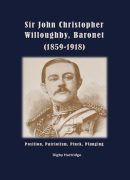
Digby is the author of the biography of Sir John Christopher Willoughby.
There is much about travel in its different guises and the African countryside in many of the following books: